
The “breakthrough” agreement will reduce British tariffs on US goods, lower US duties on car imports, and eliminate steel and ethanol tariffs
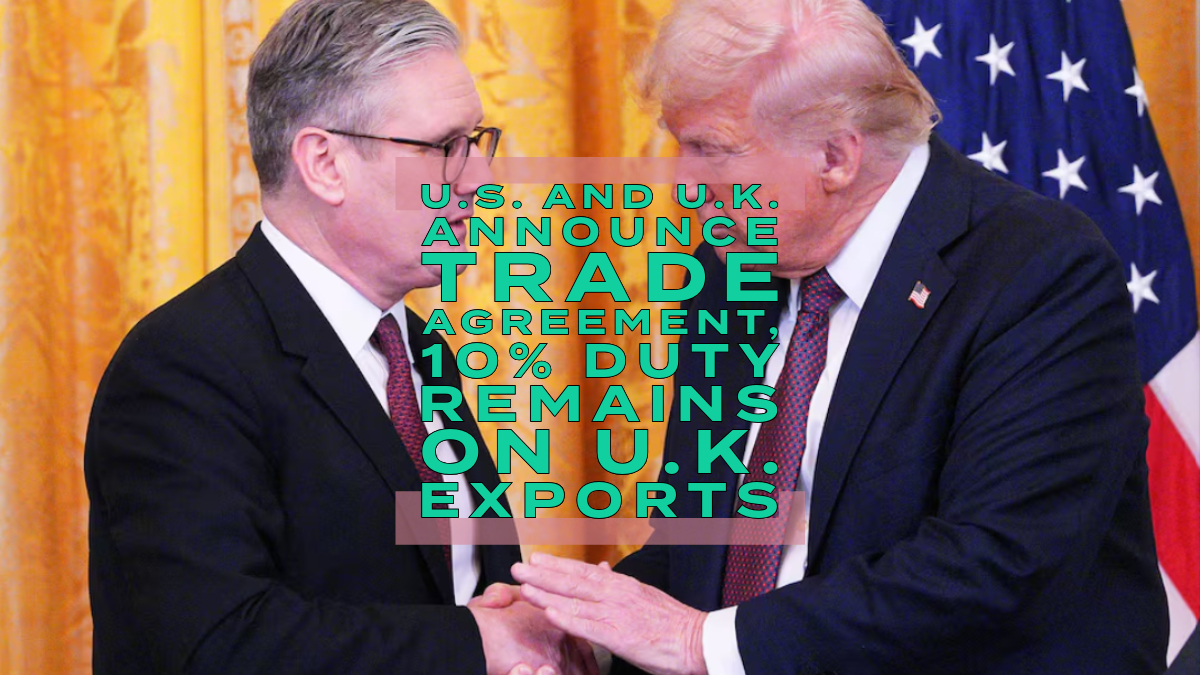
The President of the United States (U.S.) – Donald Trump and the Prime Minister of the United Kingdom (U.K.) – Keir Starmer have unveiled a limited bilateral trade agreement that modestly expands market access for both countries while keeping in place Trump’s 10% tariffs on British exports.
The agreement, described by both leaders as a “breakthrough,” lowers average British tariffs on U.S. goods from 5.1% to 1.8% and slashes U.S. duties on British car imports from 27.5% to 10% for up to 100,000 vehicles annually. It also eliminates longstanding U.S. tariffs on U.K. steel and British tariffs on U.S. ethanol and beef. However, the deal stops short of a full-scale free trade agreement and sidesteps contentious issues such as the U.K.’s digital services tax.
Speaking on the occasion, Trump said, “This opens up a tremendous market for us. I didn’t realise how many barriers our businesses were facing in Britain.”
He said that the deal with the U.K. is a model for dozens of new trade arrangements in the coming weeks. He stressed, however, that other nations with large U.S. trade surpluses may face higher tariffs than Britain.
Sharing his thoughts, Starmer said, “This is a really fantastic, historic day. This deal protects jobs, creates new opportunities, and opens new avenues for transatlantic trade.”
Other key elements of the deal include reducing U.K. tariffs on U.S. ethanol from 19% to zero under a generous 1.4 billion-litre quota. The U.S. tariffs on UK steel will be eliminated entirely. A new reciprocal beef access deal gives UK farmers a first-ever 13,000 metric tonne U.S. quota.
Other provisions include preferential UK treatment in future U.S. tariff actions under national security reviews — a concession welcomed by Starmer’s government, which also received verbal assurances that Trump would avoid targeting British films in his newly announced trade probes.
A U.K. Official also said that the U.S. and the U.K. have more serious work to do, and noted the deal did not include Washington’s demand for restructuring of Britain’s digital services tax, levied at 2% of U.K. revenue for online marketplaces. Washington could revisit the issue, but there was no agreed-upon process for doing so.
The U.S. Commerce Secretary – Howard Lutnick, said the deal could unlock U.S. $ 5 billion in new U.S. exports annually, while the tariffs retained would generate an estimated U.S. $ 6 billion in revenue. Going ahead, the Treasury Secretary, U.S. – Scott Bessent and Lead Negotiator – Jamieson Greer, now head to Switzerland for high-stakes talks with Chinese counterparts aimed at resolving a trade standoff involving tariffs over 100% on both sides. With more than 50 targeted trade deals in the pipeline, Trump’s administration is working rapidly to reshape U.S. trade relations globally.