
The treaty signalsU.K.’s renewed push to strengthen relations with key E.U. amid evolving global threats and geopolitical uncertainty
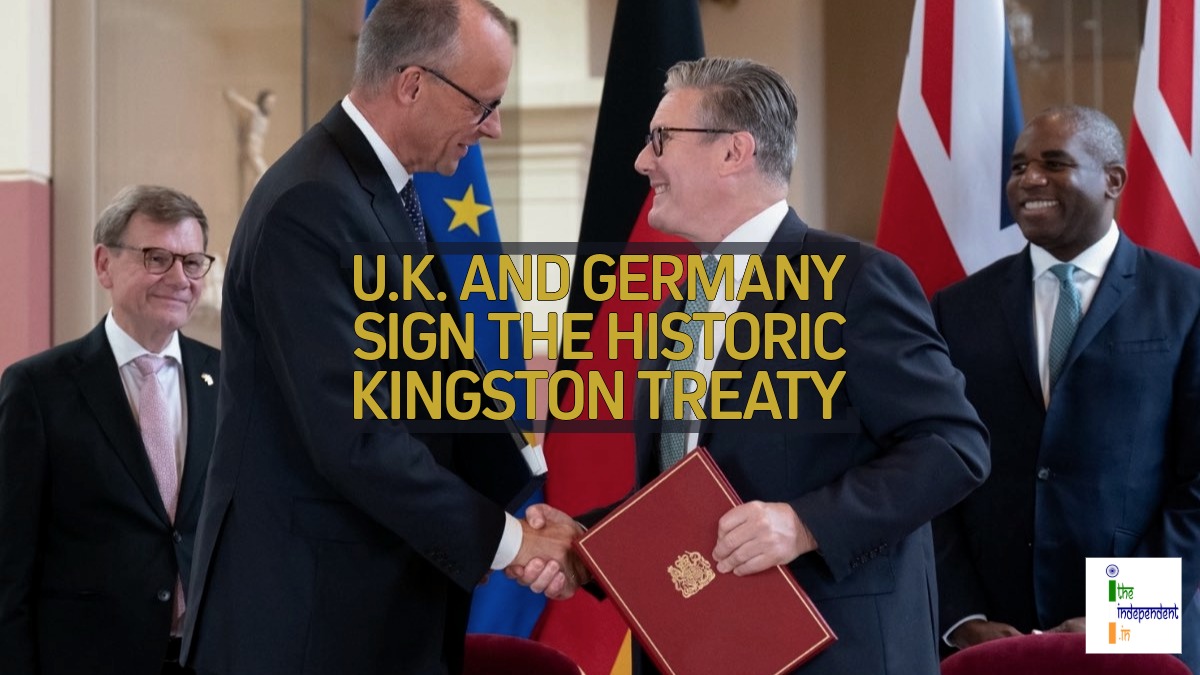
The Prime Minister of the United Kingdom (U.K.) – Keir Starmer and the Chancellor of Germany – Friedrich Merz have signed the historic Kensington Treaty, a sweeping bilateral accord aimed at enhancing cooperation across defense, economic development and immigration.
The treaty, signed at the Victoria and Albert Museum in London, co-founded by Britain’s Queen Victoria and her German-origin husband Prince Albert, marks the most significant agreement between the two nations in recent history. It also signals the U.K.’s renewed push to strengthen relations with key European Union (E.U.) amid evolving global threats and geopolitical uncertainty.
On his first trip to London as Chancellor, Merz described the Kensington treaty as historic, the first major bilateral agreement between Britain and Germany to deepen defence cooperation and to try to boost economic growth in both nations.
Addressing the Joint Press Conference, Starmer said, “We see the scale of the challenges our continent faces today, and we intend to meet them head on. The Kensington treaty is an expression of our shared aims and values. But more than that, it’s a practical work plan setting out 17 major projects where we will come together to deliver real results which will improve people’s lives.”
Taking it to X, Merz tweeted,
A historic day for German-British relations.
— Bundeskanzler Friedrich Merz (@bundeskanzler) July 17, 2025
Our treaty on friendship stands for freedom, security and prosperity — and for bringing our young generations closer together. pic.twitter.com/OIuNqGxX5X
He further tweeted,
Working together in a new chapter of our friendship – for the freedom, security, and prosperity of our people.
— Bundeskanzler Friedrich Merz (@bundeskanzler) July 17, 2025
And for a good perspective for the young generations, in Europe. We are doing this for you.
Thanks for having me in London, dear @Keir_Starmer. pic.twitter.com/GsBNx6K8ID
Standing next to Starmer at an Airbus plant, Merz again lamented Britain’s departure from the E.U., but said the agreement would cement ties between the two nations and complement an agreement London struck with France. Merz’s day trip follows a 3-day state visit to Britain by the President of France – Emmanuel Macron, signalling greater cooperation between Europe’s top three powers.
A key pillar of the treaty is enhanced defence cooperation. It builds on an earlier agreement between the two countries to jointly develop long-range strike weapons. The new accord includes a mutual assistance clause, which German officials highlighted as particularly significant given Russia’s ongoing aggression in Ukraine.
Both leaders confirmed new commitments to supplying military aid to Ukraine, including long-range strike systems and air defence technology, such as the Patriot missiles. Merz signalled that “substantial additional support” would soon be delivered to Kyiv.
In a further alignment of strategic objectives, Britain and Germany also pledged to jointly promote export campaigns for major defence equipment, such as the Typhoon Eurofighter and Boxer armoured vehicles, a marked shift from Germany’s earlier stance that had blocked sales to nations like Saudi Arabia and Turkey.
Beyond defence, the treaty also includes an agreement to develop a new direct rail link between the two countries, to allow frequent travellers access to e-gates at German airports and to support youth mobility between the two nations. In a win for Starmer, they also pledged to combat irregular migration jointly. Germany pledged to outlaw the facilitation of illegal migration to Britain, with a law change by the end of the year. That would give law enforcement the tools to investigate warehouses and storage facilities used by migrant smugglers to conceal dangerous small boats intended for illegal crossings to Britain.
The U.K.’s recent agreements with France and Germany signal a broader recalibration of European alliances. With the President of the United States (U.S.) – Donald Trump raising questions about U.S. commitment to the North Atlantic Treaty Organisation (NATO) and European defence, the U.K., France and Germany appear more determined than ever to forge a unified European front.