
U.S. has reportedly conveyed its interest in resuming nuclear negotiations, but failed to clarify its position on potential future attacks
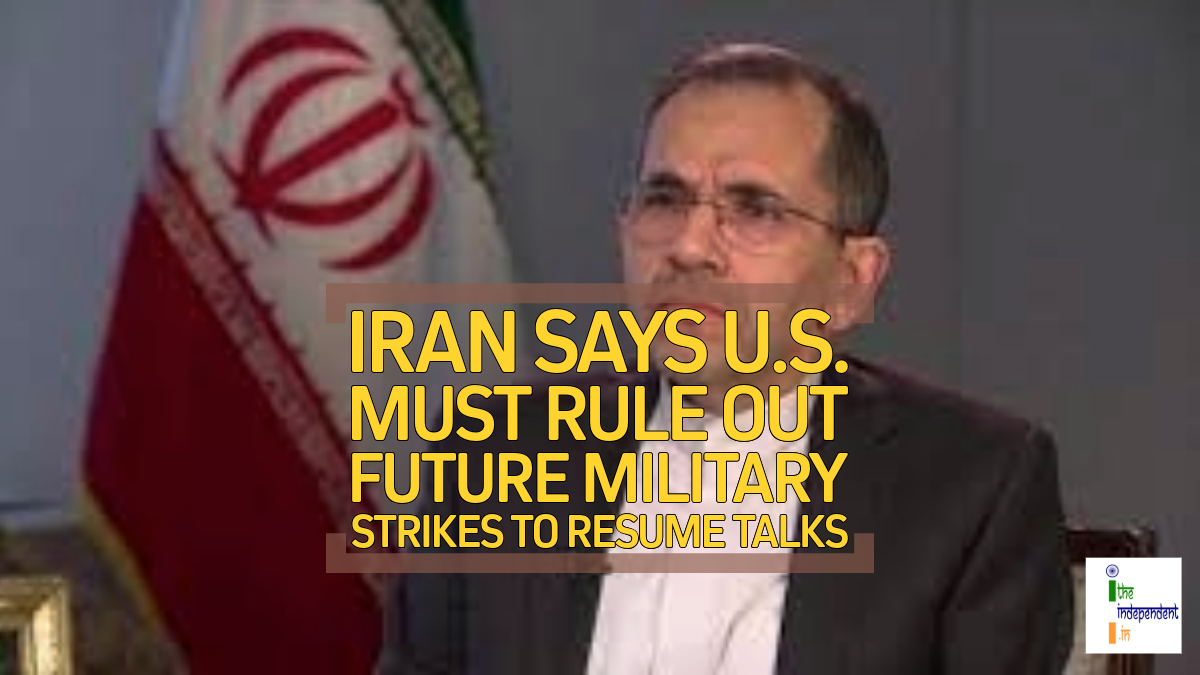
The Deputy Foreign Minister of Iran, Majid Takht-Ravanchi, has said that the United States (U.S.) must rule out future military strikes if it wants to resume diplomatic dialogue.
In an exclusive interview with the BBC, he revealed that the U.S. had recently conveyed, through intermediaries, its interest in resuming nuclear negotiations, but failed to clarify its position on potential future attacks during any such talks.
The statement comes in the wake of escalating hostilities in the region, which began earlier in June’25 when Israel launched strikes on Iranian nuclear and military infrastructure, claiming Tehran was nearing the development of a nuclear weapon. Iran responded with missile attacks targeting Israel. The conflict widened dramatically on 21st June’25, when the U.S directly intervened by bombing 3 Iranian nuclear sites at Fordo, Natanz, and Isfahan.
Speaking to the BBC, Takht-Ravanchi said, “Are we going to see a repetition of an act of aggression while we are engaging in dialogue? That is the question we need an answer to.”
He insisted that the U.S. must be unequivocal about its intentions and offer concrete reassurances to build the trust necessary for any renewed negotiations. Takht-Ravanchi also said Iran would “insist” on being able to enrich uranium for what it says are peaceful purposes, rejecting accusations that it is secretly moving towards developing a nuclear bomb. He said Iran had been denied access to nuclear material for its research programme so they needed to rely on themselves.
He further said, “The level of that can be discussed, the capacity can be discussed, but to say that you should not have enrichment, you should have zero enrichment, and if do you not agree, we will bomb you – that is the law of the jungle.”
The extent of the damage caused by the U.S. airstrikes remains uncertain. While International Atomic Energy Agency (IAEA) Chief – Rafael Grossi described the strikes as having caused “severe but not total” damage, the President of the U.S. – Donald Trump claimed that the Iranian nuclear sites were “totally obliterated.” Grossi also warned that Iran could potentially resume uranium enrichment within months. In response, Takht-Ravanchi said he could not confirm the timeline but reaffirmed Iran’s position on its right to enrichment, currently at 60%, still below weapons-grade level.
Tensions between Iran and the IAEA have grown, with the Iranian Parliament voting this week to suspend cooperation with the atomic watchdog, accusing it of bias toward the U.S. and Israel.
Meanwhile, Trump has stated that he would absolutely consider further military action if Iran moves closer to weapons-grade enrichment. While the U.S. Administration has floated the possibility of talks this week, Takht-Ravanchi said no date had been agreed upon and the agenda remained unclear.
On the question of whether Iran would scale back its nuclear program in exchange for sanctions relief and international investment, Takht-Ravanchi said, “Why should we agree to such a proposal?”
He argued that criticism of Iran’s nuclear activities often ignored the broader context of U.S. and Israeli aggression. He further said, “Those who are criticising Iran should also criticise the way that we have been treated. And if they do not have the guts to criticise America, they should keep silent.”
He reiterated that Iran’s programme, including enriching uranium to 60%, is for peaceful purposes. Under a 2015 nuclear deal with world powers, Iran was not permitted to enrich uranium above 3.67% purity, the level required for fuel for commercial nuclear power plants, and was not allowed to carry out any enrichment at its Fordo plant for 15 years. However, Trump abandoned the agreement in 2018 during his first term as President, saying it did too little to stop a pathway to a bomb, and reinstated U.S. sanctions.
He also addressed concerns over regime change, asserting that Iran had received messages from the U.S. clarifying it was not targeting the country’s Supreme Leader – Ayatollah Ali Khamenei. He dismissed any suggestion that external powers could destabilise Iran. Takht-Ravanchi also accused some European leaders of a ridiculous endorsement of U.S. and Israeli strikes.
Iran’s Arab neighbors, particularly Qatar, have reportedly played a key role in brokering the current truce. Takht-Ravanchi noted their efforts to create an atmosphere conducive to dialogue, but warned that Tehran would remain vigilant.