
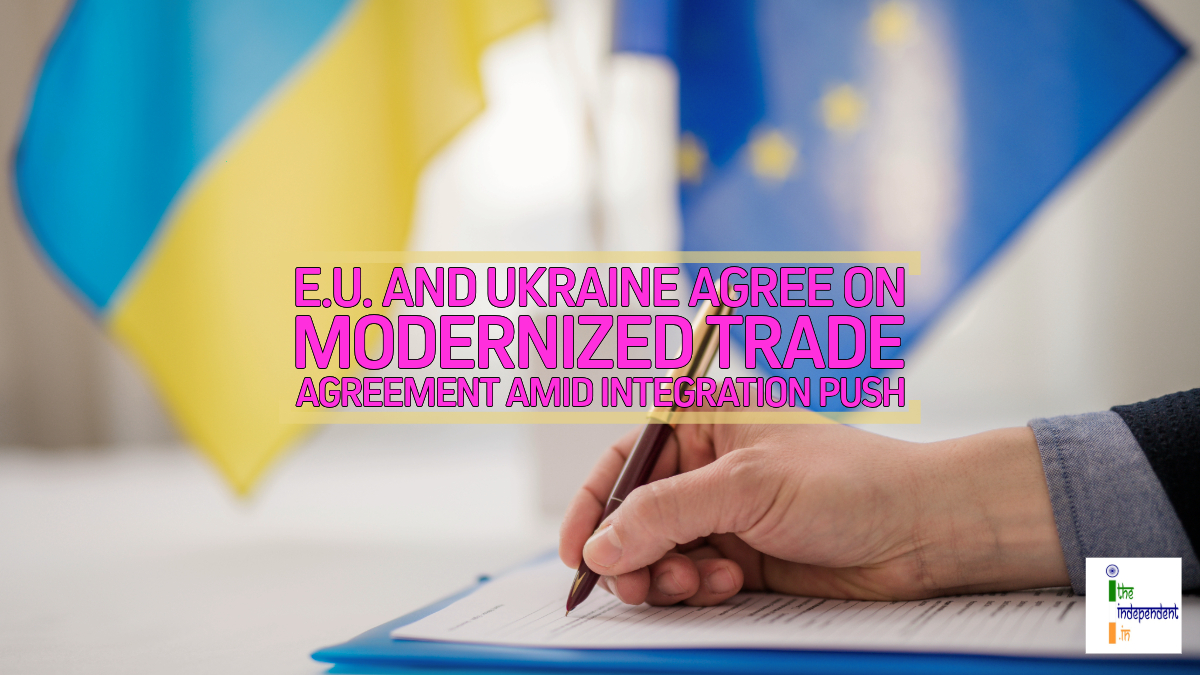
The deal marks a significant step in Ukraine’s path toward E.U. accession, laying the foundation for a long-term trade relationship
The European Commission has successfully concluded negotiations with Ukraine on the revision of the Deep and Comprehensive Free Trade Area (DCFTA), a key component of the broader European Union (E.U.) – Ukraine Association Agreement.
The deal marks a significant step forward in Ukraine’s path toward E.U. accession, laying the foundation for a long-term, reciprocal, and predictable trade relationship.
The updated agreement, reached in principle, aims to strengthen economic ties while addressing the sensitivities of key agricultural sectors, as flagged by E.U. Member States and farmers. It reflects the E.U.’s unwavering support for Ukraine amid ongoing geopolitical tensions and underscores Brussels’ commitment to the country’s gradual integration into the E.U. Single Market.
Speaking on the occasion, the President of the European Commission – Ursula von der Leyen, said, “With this modernised agreement, we are securing trade flows from Ukraine to Europe and global markets. And we are also building bridges of resilience and economic solidarity in the face of Russia’s unjustified war of aggression. At the same time, we continue to safeguard the interests of our farmers. Ukraine’s place is in the family. We remain committed to a path of mutual growth and stability, leading to its full integration in our Union.”
Taking it to X, the European Commission tweeted,
We've concluded negotiations on a long-term, predictable, and reciprocal trade relationship with Ukraine.
— European Commission (@EU_Commission) June 30, 2025
Amid Russia's war of aggression, we're establishing a long-term framework with a view to 🇺🇦 accession process, while also safeguarding 🇪🇺 interests ↓
#StandWithUkraine
The modernised agreement revolves around 3 pillars of providing a level playing field, a robust safeguard clause and enhanced trade flow. Under the ‘level-playing field’, Ukraine will gradually align with E.U. production standards in areas such as animal welfare, pesticide use and veterinary medicine. Ukraine will have to submit annual progress reports, aligning with the E.U. accession framework and broader adoption of the E.U. acquis. Under the ‘robust safeguard clause’, both parties will take protective measures if imports significantly disrupt domestic markets. In the E.U.’s case, disturbances can be assessed at both the E.U. level and individual Member State levels.
In ‘enhanced trade flows’, the revised agreement strikes a balance between supporting Ukraine’s trade with the E.U., and fully considers the sensitivities of certain E.U. agricultural sectors and stakeholders. The negotiated market access varies for the most sensitive items, such as sugar, poultry, eggs, wheat, maize, and honey. There are only modest increases compared to the original DCFTA. Enhancements have been made to benefit both sides based on complementary markets for other products. Besides, full liberalisation has been agreed upon for certain non-sensitive products.
Both sides have also agreed on exploring measures to help Ukrainian exporters reach their traditional markets in 3rd countries.
Additionally, both parties have committed to exploring new ways to support Ukrainian exporters in accessing traditional third-country markets. Furthermore, the E.U. and Ukraine have also agreed to review the situation in the context of their progress in economic integration and their accession prospects.
Going ahead, the finalisation of technical details is underway, with the European Parliament and Member States set to be briefed shortly. Subject to final legal revision of the agreement in principle, the E.U. and Ukraine will then proceed with their respective procedures for the formal endorsement of the reviewed DCFTA.